Lead Construction Product Manager: Build Your Future!
Are you a seasoned construction product manager ready to lead? Drive innovation and shape the future of construction with a leading US company. This role demands strategic thinking, strong leadership, and a passion for delivering exceptional products.
Essential Skills for Lead Construction Product Manager
Include these keywords in your resume to pass ATS screening and impress recruiters.
Must-Have Skills
- Communication
- Time Management
- Construction Industry Knowledge
- Product Strategy
- Agile Methodologies
Technical Skills
- BIM Software (e.g., Revit, ArchiCAD)
- Project Management Software (e.g., Procore, PlanGrid)
- Data Analysis Tools (e.g., Excel, SQL)
- CRM Software (e.g., Salesforce)
- Cloud Computing Platforms (e.g., AWS, Azure)
Soft Skills
A Day in the Life
As a Lead Construction Product Manager, your day starts with checking in with your team, reviewing progress on current product development sprints, and addressing any roadblocks. You then dive into market research, analyzing competitor offerings and emerging industry trends. A significant portion of your morning is dedicated to a cross-functional meeting with engineering and marketing, discussing the upcoming launch of a new BIM integration feature. After lunch, you're deeply involved in user interviews, gathering feedback on a prototype for a new prefabrication planning tool. The afternoon concludes with preparing a presentation for executive leadership, outlining the product roadmap for the next quarter and justifying resource allocation based on ROI projections. Throughout the day, you’re constantly communicating, problem-solving, and strategizing to ensure that your team delivers innovative and valuable construction products that meet the evolving needs of the market.
Career Progression Path
Junior Product Manager
Product Manager
Senior Product Manager
Lead Product Manager
Director of Product Management
Interview Questions & Answers
Prepare for your Lead Construction Product Manager interview with these commonly asked questions.
Describe a time you had to make a difficult decision regarding a product roadmap. What were the factors you considered, and what was the outcome?
MediumSTAR: Situation: We had two competing features for our next product release – one focused on cost estimation and the other on project scheduling. We had limited resources and couldn't deliver both. Task: I needed to decide which feature to prioritize. Action: I gathered data on market demand for each feature, conducted user interviews, and analyzed the potential ROI. I also considered the strategic alignment with our overall product vision. Result: Based on the data, I recommended prioritizing the cost estimation feature, as it addressed a more pressing pain point for our target audience and had a higher potential ROI. The feature was successfully launched and led to a significant increase in user engagement.
How do you stay up-to-date on the latest trends and technologies in the construction industry?
EasyI actively participate in industry conferences, subscribe to relevant publications and blogs, and network with other professionals in the field. I also regularly research emerging technologies and trends, such as BIM, prefabrication, and sustainable building practices. I also follow key influencers on LinkedIn and attend webinars on relevant topics regularly. This allows me to anticipate future needs and ensure our products remain competitive.
Explain your experience with Agile methodologies and how you've applied them in product management.
MediumI have extensive experience working in Agile environments, utilizing Scrum and Kanban frameworks. I've led sprint planning meetings, facilitated daily stand-ups, and conducted sprint retrospectives. My focus is on iterative development, continuous improvement, and close collaboration with the development team. I use user stories to define product requirements and prioritize the product backlog based on business value and technical feasibility.
Describe a time you had to manage a conflict between different stakeholders regarding product priorities.
HardSituation: During the development of a new mobile app feature, the sales team wanted to prioritize a feature that would help them close deals faster, while the engineering team argued for a feature that would improve the app's performance. Task: I needed to resolve this conflict and determine the best course of action. Action: I facilitated a meeting with both teams, listened to their perspectives, and presented data on the potential impact of each feature. I also emphasized the importance of aligning with our overall product strategy. Result: After a productive discussion, we agreed to prioritize the performance enhancement feature, as it would ultimately improve the user experience and lead to long-term customer satisfaction. The sales team understood the rationale and supported the decision.
How do you measure the success of a construction product?
MediumI use a variety of metrics to measure product success, including user adoption rate, customer satisfaction scores, revenue growth, and market share. I also track key performance indicators (KPIs) such as the number of completed projects using our product, the time savings achieved by users, and the reduction in construction costs. I continuously monitor these metrics and make data-driven decisions to optimize product performance.
Tell me about a time you failed in a product management role and what you learned from it.
HardSituation: In a previous role, I launched a new feature without conducting sufficient user testing. Task: The feature was intended to streamline a key workflow, but it ended up being confusing and difficult to use. Action: I quickly realized my mistake and took immediate action to gather user feedback and identify the root causes of the problem. Result: I worked closely with the engineering team to make the necessary changes and relaunched the feature after thorough user testing. I learned the importance of prioritizing user feedback and conducting rigorous testing before launching any new product or feature. This experience has made me a more cautious and data-driven product manager.
What are your salary expectations for this Lead Construction Product Manager role?
MediumBased on my research of similar roles in the United States and considering my experience and skills, I am looking for a salary in the range of $140,000 to $160,000 per year. However, I am open to discussing this further based on the specific responsibilities and benefits of the position.
ATS Optimization Tips
Make sure your resume passes Applicant Tracking Systems used by US employers.
Use standard section headings: 'Professional Experience' not 'Where I've Worked'
Include exact job title from the posting naturally in your resume
Add a Skills section with Construction-relevant keywords from the job description
Save as .docx or .pdf (check the application instructions)
Avoid tables, text boxes, headers/footers, and images - these confuse ATS parsers
Common Resume Mistakes to Avoid
Don't make these errors that get resumes rejected.
Lack of specific construction industry experience.
Failure to quantify product impact with metrics.
Poor communication of technical concepts to non-technical stakeholders.
Insufficient understanding of the entire product lifecycle.
Neglecting to tailor the resume to the specific job description.
Industry Outlook
The US market for Lead Construction Product Manager professionals remains highly competitive. Recruiters and ATS systems prioritize action verbs, quantifiable outcomes (e.g., "Reduced latency by 40%", "Led a team of 8"), and clear alignment with job descriptions. Candidates who demonstrate measurable impact and US-relevant certifications—coupled with a one-page, no-photo resume—see significantly higher callback rates in major hubs like California, Texas, and New York.
Top Hiring Companies
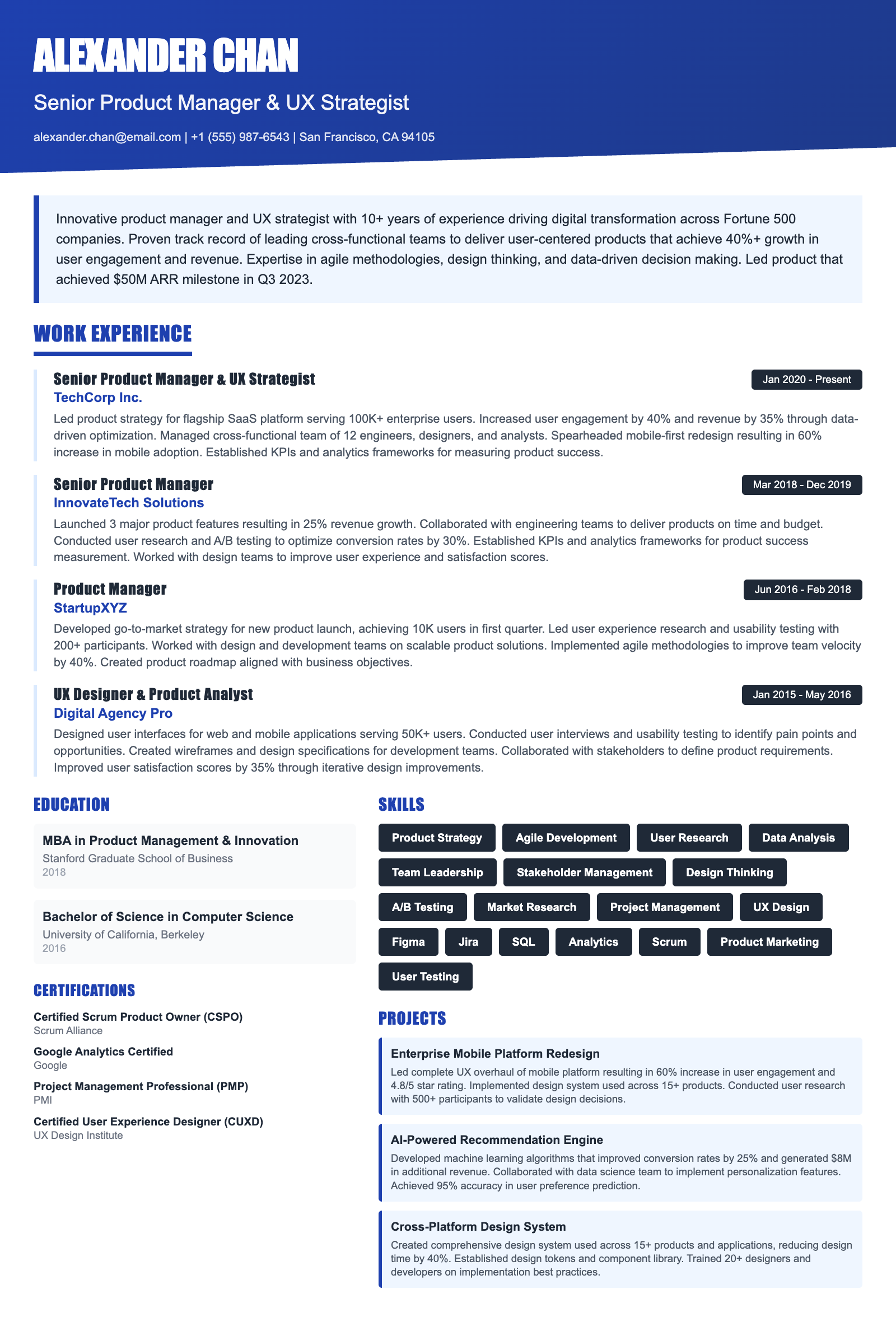
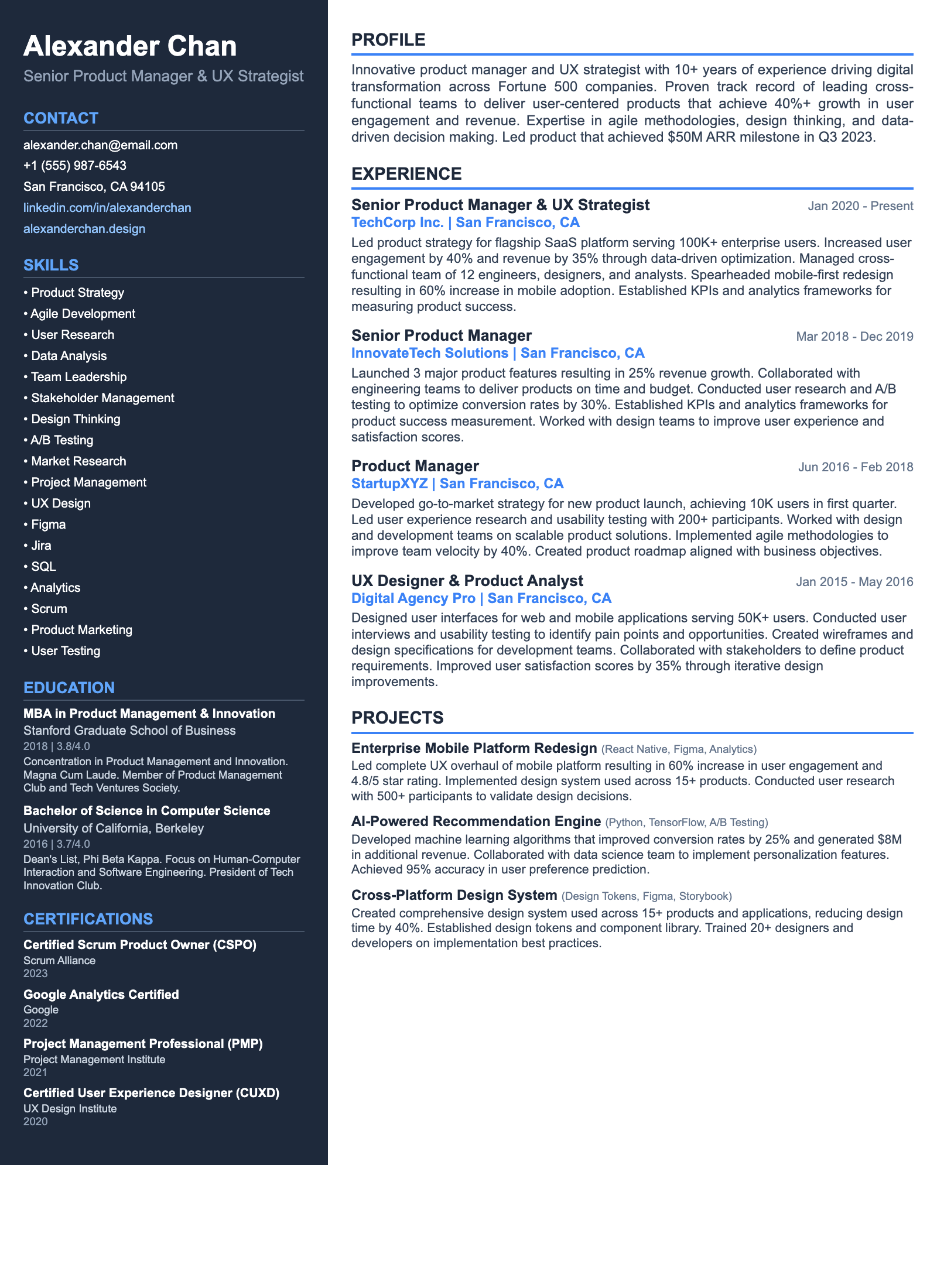
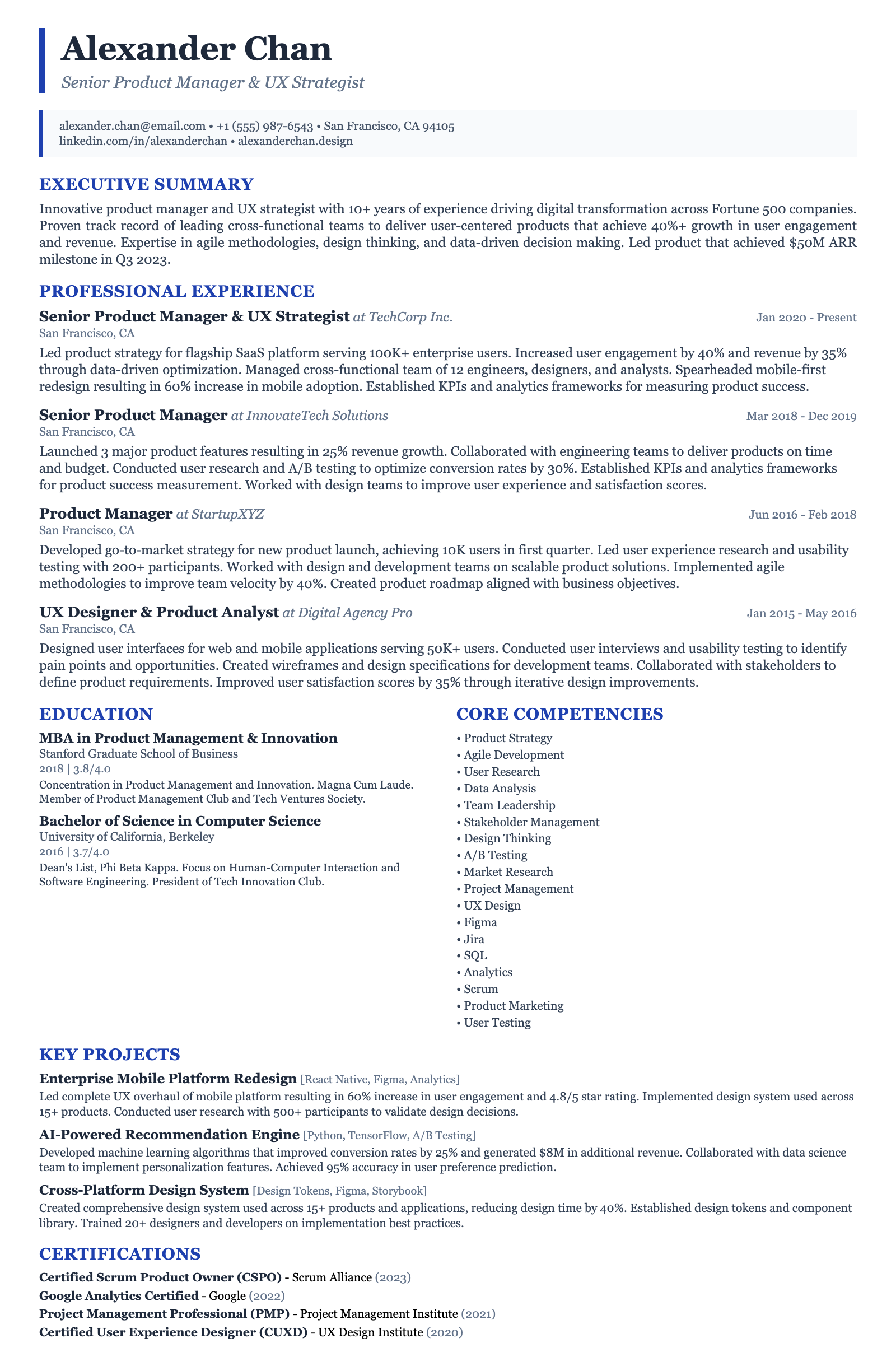
Recommended Resume Templates
ATS-friendly templates designed specifically for Lead Construction Product Manager positions in the US market.
Frequently Asked Questions
What is the typical career path for a Construction Product Manager?
The typical career path starts with roles like Junior Product Manager or Business Analyst, progresses to Product Manager and Senior Product Manager, and eventually to leadership positions such as Lead Product Manager, Director of Product Management, and VP of Product.
What are the most important skills for a Lead Construction Product Manager?
The most important skills include strong communication, leadership, strategic thinking, construction industry knowledge, product management expertise, and the ability to work cross-functionally.
What types of companies hire Construction Product Managers?
Construction Product Managers are hired by software companies that develop solutions for the construction industry, construction companies themselves, and companies that provide building materials or equipment.
What is the difference between a Product Manager and a Project Manager?
A Product Manager is responsible for the overall strategy and vision of a product, while a Project Manager is responsible for executing a specific project to deliver that product or feature. The Product Manager defines the 'what' and 'why,' while the Project Manager focuses on the 'how' and 'when.'
What is BIM and why is it important for Construction Product Managers?
BIM (Building Information Modeling) is a digital representation of physical and functional characteristics of a facility. It's crucial for Construction Product Managers because it's becoming increasingly prevalent in the industry and influences the design, construction, and operation of buildings.
How important is data analysis in this role?
Data analysis is highly important. A Lead Construction Product Manager needs to use data to understand user behavior, track product performance, identify areas for improvement, and make informed decisions about product strategy and roadmap.
What are the biggest challenges facing the construction industry today?
Some of the biggest challenges include labor shortages, rising material costs, increasing regulatory requirements, and the need for greater efficiency and sustainability. Product Managers play a crucial role in developing solutions to address these challenges.
What kind of impact can a Lead Construction Product Manager have on a company?
A Lead Construction Product Manager can have a significant impact by driving innovation, improving product performance, increasing customer satisfaction, and ultimately contributing to the company's revenue growth and market share. They are instrumental in shaping the future of the company's product offerings.
Ready to Build Your Lead Construction Product Manager Resume?
Use our AI-powered resume builder to create an ATS-optimized resume tailored for Lead Construction Product Manager positions in the US market.